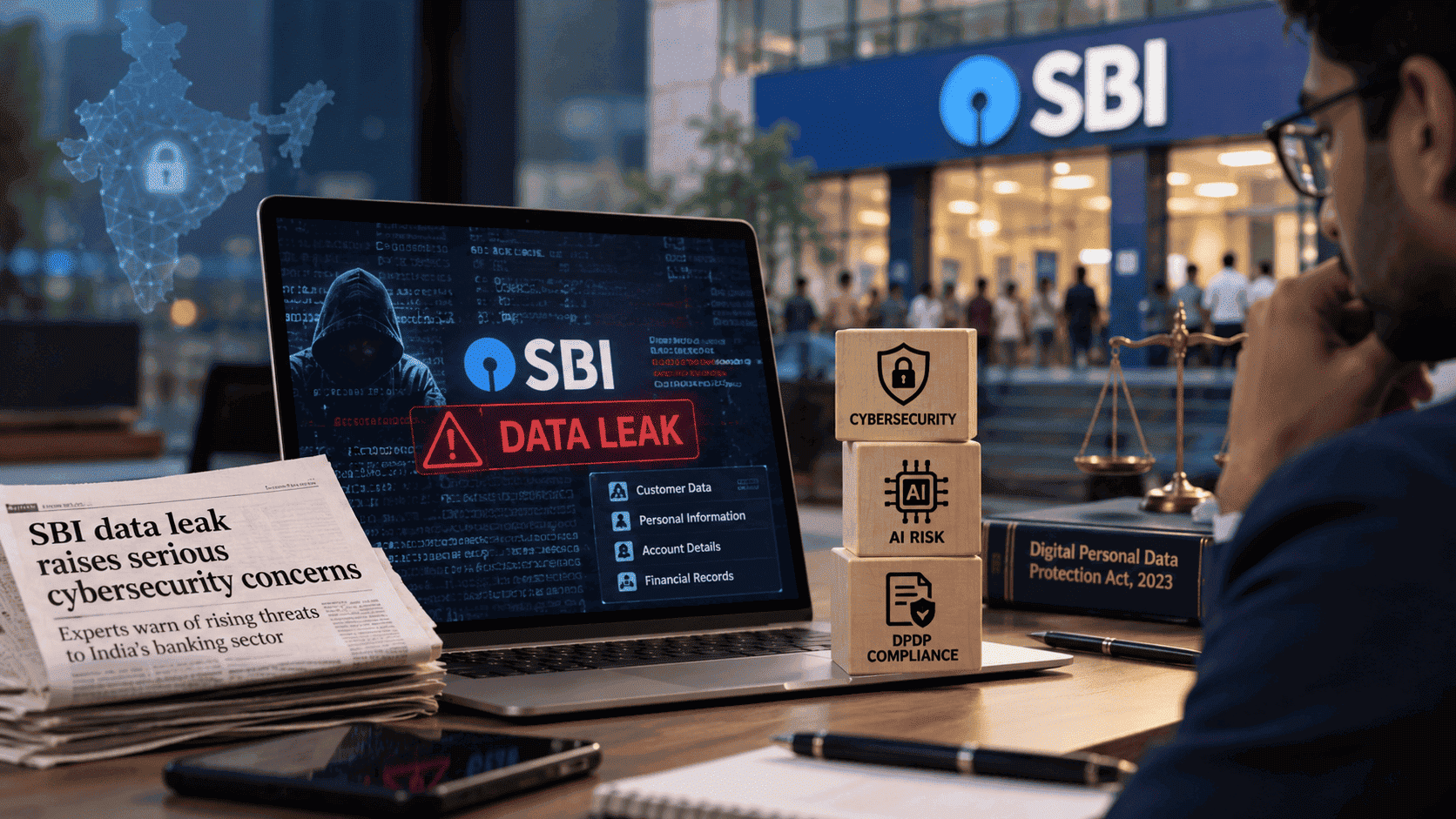

A Digital Task Force Cyber Security Intelligence Analysis
India's banking ecosystem has undergone a remarkable digital transformation. Internet banking, mobile banking, UPI transactions, digital lending and online customer onboarding have made financial services more accessible than ever before.
However, the same digital infrastructure that enables convenient banking also creates substantial responsibilities for protecting customer information.
In October 2026, reports concerning the exposure of customer information associated with the State Bank of India (SBI) raised important questions about banking Cyber Security, personal data protection and the potential misuse of financial information.
According to publicly reported information, approximately 375,000 records allegedly associated with SBI appeared on the dark web. Following preliminary examination, the bank identified 3,897 customer records containing personally identifiable information.
SBI acknowledged an incident involving the loss of certain data, activated its cyber incident response procedures and engaged an independent CERT-In-empanelled Cyber Security agency to investigate.
The bank also stated that the incident had not materially affected its core business operations, financial performance or business continuity.
This distinction is important.
The exposure of customer information does not automatically establish that customer bank accounts have been compromised or that money has been stolen.
Nevertheless, exposed personal information can create significant downstream risks, including impersonation, phishing, identity fraud and targeted financial scams.
For banking customers, the incident is a reminder that protecting money also requires protecting identity.
For Cyber Security professionals, it highlights the importance of continuous monitoring, forensic readiness, third-party security and effective data governance.
The reported incident became publicly significant following alerts concerning customer information allegedly circulating on the dark web.
16 October 2026 — Security Alerts
According to SBI's reported stock-exchange disclosure, the bank received information concerning the suspected data exposure from its threat intelligence service provider, the Defence Cyber Agency and the Indian Computer Emergency Response Team (CERT-In).
21 October 2026 — Public Disclosure
SBI disclosed that it had experienced an incident involving the loss of certain data.
The bank stated that preliminary examination of approximately 375,000 records had identified 3,897 customer records containing personally identifiable information.
22 October 2026 — Continued Public Reporting
News coverage highlighted the nature of the exposed information, the bank's investigation and the potential implications for customers.
The precise source, mechanism and complete scope of the exposure remained subjects of investigation.
Reported categories of personal information included:
These categories are particularly important because they can be combined to create convincing fraudulent communications.
For example, a criminal possessing a customer's name, mobile number, banking relationship and loan-related information may be able to construct a highly personalized impersonation attempt.
The presence of such information does not prove that the criminal can access the customer's account. It does, however, create opportunities for social engineering.
This question requires careful interpretation.
The reported dataset contained approximately 375,000 records, while preliminary analysis identified 3,897 customer records containing personal information.
These figures are not interchangeable.
A record may represent a document, database entry, duplicate, metadata item or other digital artifact. It does not necessarily correspond to one unique customer.
Furthermore, the authenticity, completeness and relationship of all records to SBI had not been conclusively established.
Therefore, the number of records should not be presented as the confirmed number of affected customers.
The dark web refers to online services and resources that are not ordinarily indexed by conventional search engines and may require specialized networks or software to access.
Although privacy-focused networks have legitimate uses, criminal marketplaces and forums may also operate within these environments.
Stolen or exposed information can be advertised, exchanged or redistributed through such channels.
Common categories include:
When customer information appears on the dark web, investigators must determine whether the material is authentic, current, previously exposed, duplicated or obtained through a newly identified compromise.
A dark web listing is evidence of a claim or publication. It is not, by itself, proof of the attacker's claimed method of intrusion.
This distinction is essential to responsible digital forensic investigation.
Not necessarily.
There is a fundamental difference between exposure of personally identifiable information and compromise of transaction authorization systems.
A bank account may remain technically protected even when customer contact details have been exposed.
For example, disclosure of a mobile number, address or date of birth does not automatically provide an attacker with a valid banking password, transaction PIN, OTP or authenticated banking session.
However, the exposed information may help criminals persuade victims to disclose those additional credentials.
This creates an indirect but potentially serious financial risk.
A fraudster may contact a customer while pretending to represent the bank.
The caller may already know the customer's name, mobile number and other personal details.
That familiarity can make the communication appear authentic.
The fraudster may then claim that:
The attack succeeds not because the criminal has broken the banking application, but because the victim is manipulated into authorizing or facilitating an unauthorized action.
Phishing messages may become more convincing when attackers possess accurate personal information.
A generic message requesting a banking update is relatively easy to recognize.
A personalized message referencing a customer's name, branch or loan relationship may be more persuasive.
Fraudsters may distribute malicious links through SMS, email or messaging applications.
These links can lead to counterfeit banking websites designed to capture credentials.
Loan-related metadata may increase the credibility of fraudulent lending communications.
Criminals may impersonate loan officers, request processing fees, solicit identity documents or attempt to obtain additional information.
The actual feasibility of unauthorized lending depends on the financial institution's identity verification and fraud prevention controls.
Personal information can also support scams involving impersonation of police officers, regulators or investigative agencies.
A fraudster may reference authentic personal details to make fabricated allegations appear credible.
Victims may be threatened with arrest, account freezing or legal proceedings unless they transfer money.
There is no lawful procedure under which a person is placed under a so-called digital arrest through a video call and instructed to transfer money to establish innocence.
Such demands should be treated as warning signs of fraud.
A professional investigation must go beyond confirming that records have appeared online.
It should establish what happened, how it happened, which information was affected and whether the exposure remains active.
Investigators first assess whether the published records are authentic.
This may involve comparing a carefully controlled sample with authoritative records, examining metadata and checking for duplication or fabrication.
Sensitive information must be handled under lawful authorization and strict confidentiality controls.
Relevant evidence may include:
Evidence should be preserved with documented acquisition procedures, integrity verification and chain-of-custody records.
Investigators evaluate plausible exposure pathways.
These may include compromised credentials, insecure applications, unauthorized exports, cloud misconfigurations, supplier access or malicious insider activity.
These are investigative hypotheses, not established causes of the SBI incident.
The investigation should establish:
The objective is to identify the failure or combination of failures that enabled the incident.
Possible control weaknesses include:
No particular weakness should be attributed to SBI without supporting evidence.
Remediation must address the verified root cause.
Actions may include revoking compromised credentials, correcting configurations, restricting unnecessary access, improving monitoring and conducting independent security testing.
A follow-up assessment should verify that identified weaknesses have been addressed.
Customers should respond proportionately, without panic.
Do not assume a caller is genuine simply because they know your personal details.
Contact the bank through its official website, application or independently verified customer support channels.
Do not disclose:
Bank representatives do not need these credentials to investigate a reported data leak.
Review account statements and transaction notifications.
Report unfamiliar transactions promptly.
Enable strong authentication wherever available.
Review account recovery settings and remove unfamiliar devices or sessions.
Do not submit identity documents through unsolicited links or messaging applications.
If you receive an unexpected loan approval, repayment demand or verification request, independently confirm its authenticity.
In India, victims of suspected financial Cyber Crime can contact the national Cyber Crime helpline at 1930 and submit a complaint through the official National Cyber Crime Reporting Portal.
Rapid reporting may improve the possibility of timely intervention, although recovery is not guaranteed.
CERT-In is India's national agency for responding to specified Cyber Security incidents.
Its 2022 directions establish reporting obligations for covered entities and require specified categories of cyber incidents to be reported within six hours of being noticed or brought to the entity's attention.
The directions also establish requirements concerning ICT log retention, subject to their applicability and related guidance.
Financial institutions must additionally evaluate applicable RBI Cyber Security, operational risk, outsourcing and incident reporting requirements.
The appropriate reporting obligations depend on the entity, incident classification and regulatory framework.
Traditional banking security has often emphasized preventing unauthorized transactions.
Modern data protection requires a broader perspective.
Customer information may be misused even when no money is immediately withdrawn.
For example, exposed personal data can support:
This makes data minimization, retention governance, access control and secure processing essential components of banking Cyber Security.
The Digital Personal Data Protection Act, 2023 establishes an important statutory framework for protecting digital personal data in India.
However, organizations must distinguish between provisions already in force and obligations subject to phased commencement.
The broader compliance implications are examined in the second article of this series.
The central lesson is not simply that personal information can appear on the dark web.
It is that Cyber Security incidents must be evaluated across three interconnected dimensions:
Technical security: Were appropriate preventive, detective and corrective controls implemented?
Forensic accountability: Can investigators reliably determine the source, scope, timeline and consequences of the exposure?
Customer protection: Can affected individuals receive meaningful guidance and protection against subsequent fraud?
An effective response requires all three.
A technically contained incident can still create lasting customer risks if exposed personal information remains available to criminals.
Likewise, a security investigation is incomplete if its findings do not translate into stronger governance and preventive controls.
Digital Task Force provides specialist services covering:
Our approach integrates technical investigation, evidence integrity, regulatory awareness and practical remediation.
The October 2026 SBI data exposure illustrates an important principle of modern financial Cyber Security.
Protecting customer funds and protecting customer information are related but distinct responsibilities.
A customer may face no immediate financial loss yet remain exposed to impersonation, phishing and identity-based fraud.
Financial institutions must therefore combine secure banking infrastructure with continuous data governance, effective monitoring, forensic readiness and customer awareness.
For customers, vigilance remains essential.
For financial institutions, the incident reinforces the need to examine whether existing controls are sufficient to prevent, detect and investigate the unauthorized exposure of personal information.
A secure banking system must protect not only the money customers deposit, but also the identity and information they entrust to the institution.
The next article examines the incident from the perspective of bank management, CISOs, risk committees and compliance professionals. It explores Information Security Audits, VAPT, third-party governance, AI-enabled threats, incident response and India's evolving data protection obligations.
Read Part 2Concerned about a data exposure, cyber fraud incident or suspected compromise?
Digital Task Force provides Cyber Crime investigation, digital forensics, incident response and information security assessment services.
Digital Task Force — Cyber Security | Digital Forensics | Digital Trust
Get In Touch© 2026 Digital Task Force (ISO-9001 : 2015 & ISO/IEC 27001 : 2022 Certified)
